

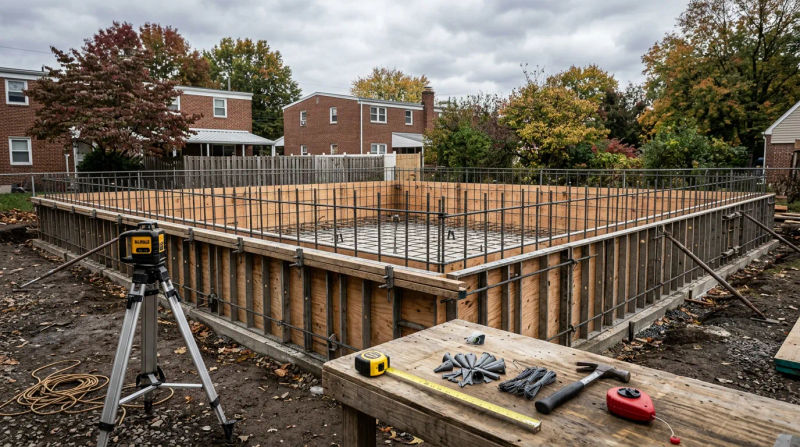
As a Senior Concrete Foreman with over 18 years in the field here in Delaware County, I can tell you the first question on nearly every homeowner's mind is, "What's this going to cost?" It's a fair question, and getting a straight answer can be tough. When you're considering a project as significant as a poured concrete wall, you deserve transparency. My goal here is to break down the real costs you can expect and explain what drives those numbers, so you can budget with confidence.
Here in October, as the leaves start to pile up, it's the perfect time to start planning. Getting your budget and contractor lined up now helps you schedule work around the colder weather, ensuring your project is on the books before winter conditions can slow down a pour.
Average Costs in Collingdale
Let's get right to it. For a standard residential poured concrete wall, homeowners in our area should expect to budget somewhere in the range of $120 to $225 per linear foot for an 8-foot high wall. This is a broad range, but it serves as a solid starting point for initial budgeting.
So, for a 40-foot long foundation wall, you could be looking at a total cost between $4,800 and $9,000. This typical cost per linear foot poured wall PA estimate generally includes:
- Labor: A trained crew for excavation, forming, pouring, and finishing.
- Materials: Concrete, formwork, and standard steel rebar reinforcement.
- Basic Site Prep: Minor excavation and grading for the wall itself.
- Equipment: Costs associated with concrete trucks, tools, and form removal.
This range reflects the typical poured concrete wall pricing Collingdale residents encounter. However, several critical factors can shift your final price to either the lower or higher end of that spectrum, and it's important to understand them.
Factors That Affect Price
No two jobs are identical, especially in a place like Collingdale with its unique housing stock. Many of the homes here date back to the pre-1940s era, featuring rowhome and twin designs on tight lots. These site-specific details play a huge role in the final poured concrete wall cost.
Here’s what our technicians look at when building an estimate:
- Wall Dimensions & Design: The single biggest factor is the amount of material needed. A 10-foot high, 10-inch thick wall will cost significantly more than an 8-foot high, 8-inch thick wall due to the increased volume of concrete and rebar required. Curves, numerous corners, or openings for windows and doors also add complexity and labor time to the form-setting process.
- Site Access: This is a major consideration in Collingdale. The tight lots and narrow driveways common to the area's older rowhomes can make it impossible for a standard concrete mixer truck to get close to the pour site. In these cases, we have to use a concrete pump truck, which adds a significant cost to the project but is often the only way to get the job done efficiently and correctly.
- Excavation & Demolition: The estimate assumes standard soil conditions. If we encounter heavy rock, unstable soil that requires extra shoring, or extensive root systems, excavation costs will rise. Furthermore, many older homes have failing fieldstone or brick foundations that must be demolished and removed before a new wall can be poured. This demolition adds both labor and disposal fees to the project scope.
- Reinforcement (Rebar): The concrete wall labor and rebar cost is a key component of the total price. While a standard amount of rebar is included in most estimates, load-bearing foundation walls or tall retaining walls require a heavier grid of steel reinforcement to ensure structural integrity. This is dictated by engineering requirements and building codes, not contractor preference.
- Waterproofing & Drainage: A basic damp-proofing application is standard for many foundation walls. However, if your property has issues with groundwater or you're finishing a basement, a more robust waterproofing membrane and a French drain system are essential. These systems are an added investment but are critical for preventing costly water damage down the road.
How to Get the Best Value
Getting the best value doesn't mean finding the cheapest price. In my experience, the lowest bid often cuts corners on things you can't see, like proper reinforcement or concrete strength. True value comes from getting a durable, long-lasting wall at a fair price.
- Plan for a Comprehensive Solution: Don't just replace a wall; solve the problem that caused it to fail. If water pressure was the issue, invest in proper drainage. A good contractor will diagnose the root cause, not just treat the symptom.
- Clear the Area Yourself: If you're able, you can reduce labor costs by handling some of the initial site prep. This could include removing shrubs, small sheds, fences, or other obstructions from the work area before the crew arrives. Just be sure to coordinate this with your contractor.
- Bundle Projects: If you’re also thinking about a new concrete patio or walkway, having it done at the same time as your wall can save money. The crew and equipment are already on-site, which reduces the mobilization costs that would be part of a separate project.
- Prioritize Quality Over Speed: A well-organized workflow is efficient, but rushing a concrete pour leads to mistakes. A reliable crew follows standardized processes for forming, pouring, and curing to ensure maximum strength and durability. This focus on process is more important than just getting it done fast.
Questions to Ask Your Contractor
When you get estimates, you're not just buying concrete; you're hiring a team and their expertise. To ensure you're comparing apples to apples and hiring a true professional, ask these questions:
- Can I get an itemized quote? A professional quote should break down costs for labor, materials, equipment (like a pump truck), and permits.
- How will you handle site access on my property? This shows if they've considered the specific challenges of your Collingdale lot.
- What concrete mix (PSI strength) and rebar schedule do you propose for this wall, and why? Their answer will reveal their understanding of the structural needs of your project.
- What is included in your site prep and cleanup process? You want to know if they will handle all excavation, backfilling, and final grading, or if that's a separate cost.
- Are you fully licensed and insured in Pennsylvania? Never hire a contractor who can't provide proof of liability and worker's compensation insurance.
- What does your project timeline look like, and how do you manage potential weather delays? This is especially important when planning work in the fall or spring.
Understanding the cost of a poured concrete wall is the first step toward a successful project. While online calculators can give you a rough idea, the unique characteristics of your property are what truly define the final scope and price. Taking the time to get a detailed, on-site estimate from a qualified professional is the only way to create an accurate budget.
For a personalized estimate that takes into account the specific needs of your Collingdale home, contact Chris Falcone Concrete for a free consultation. Our team can help you plan a project that fits both your site and your budget.