
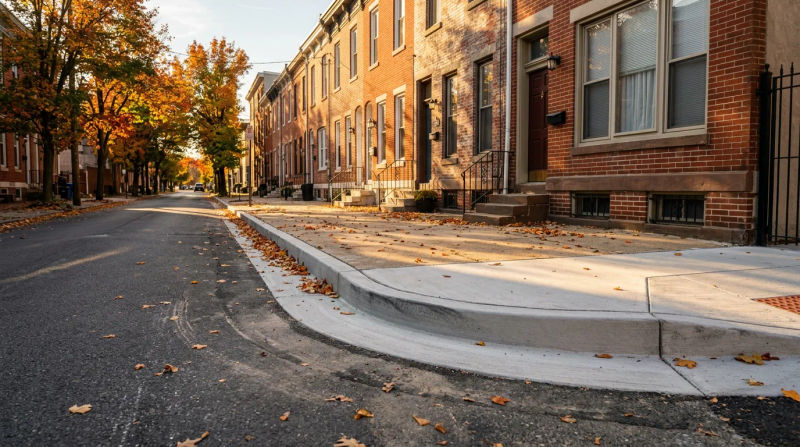
As a Senior Foreman with Chris Falcone Concrete, I’ve seen just about every kind of concrete challenge this city can throw at you. But a call we received this past October from a homeowner in a classic pre-1940s rowhouse neighborhood in Philadelphia really stuck with me. The homeowner was frustrated. The heavy autumn leaf fall wasn’t just a seasonal chore; it was a daily battle. His original concrete curbs, likely as old as the 1930s-era brick house itself, were crumbling. Chunks were missing, cracks had become chasms, and the curb line was practically nonexistent. Every time it rained, water and leaves pooled up, creating a slippery, messy hazard right at the edge of his property. He was worried about the coming winter, knowing that freeze-thaw cycles would only turn a bad situation into a complete failure.
He needed a permanent solution, not a patch job. He needed new Philadelphia concrete curbs that would not only look good but also stand up to city life - snowplows, street sweepers, and the constant wear and tear of a tight urban street. He found Chris Falcone Concrete online and asked if we could get the job done right, and get it done before the first hard frost set in.
The Assessment
When my crew and I arrived on-site, we saw a textbook case of age-related concrete failure. The original curbs were likely hand-formed back when the house was built, using materials and techniques that simply don't compare to modern standards. Over nearly a century, water had infiltrated the porous concrete, and decades of freeze-thaw cycles had caused extensive spalling - the surface was flaking and peeling away, exposing the aggregate underneath. In several spots, the curb had completely disintegrated, leaving nothing but a dirt edge where a clean concrete line should have been.
This wasn't just a cosmetic issue; it was a functional and safety problem. The lack of a proper curb meant poor water management, leading to potential erosion and water issues along the sidewalk and front yard. It was also a significant trip hazard for pedestrians. As I walked the property line, I noted the specific challenges of the location. This was a dense Philadelphia street with narrow sidewalks and steady foot traffic. Our work would require careful planning to manage:
- Staging and Debris Removal: We had very little space to stage materials or park our equipment. All demolition debris would need to be loaded out immediately to keep the site safe and accessible.
- Pedestrian and Vehicle Flow: We had to ensure a safe path for neighbors walking by and manage our work around parked cars and local traffic.
- Protecting Existing Structures: The adjacent sidewalk and the asphalt street were in decent condition. Our demolition process had to be precise to avoid damaging them.
This initial survey is a critical part of the Chris Falcone Concrete process. It's not just about quoting a price; it's about developing a detailed, efficient, and safe plan of action. We confirmed with the homeowner that a full concrete curb demo and repour Philadelphia was the only viable long-term solution.
Our Solution
With a clear plan approved by the homeowner, our 5-person crew got to work. We executed the project in a systematic, three-day process designed for maximum efficiency and minimal disruption.
Day 1: Precision Demolition and Site Prep Our first step was a clean and controlled demolition. We started by making precise saw cuts along the edge where the old curb met the sidewalk and the street. This prevents uncontrolled cracking and protects the adjacent surfaces. With the cuts made, we used electric jackhammers to break up the old, failing concrete into manageable pieces. Our crew worked in tandem, with two men on the jackhammers and two others loading the debris directly into our dump truck. By the end of the day, all the old curb was gone, and the site was swept clean, leaving a prepared trench ready for the new installation.
Day 2: Forming for Strength and Aesthetics This is where craftsmanship really comes into play. A great curb is all about clean lines and proper elevation. We began by grading and compacting the sub-base to create a solid foundation for the new concrete. Then, we meticulously set up our steel-faced curb forms. For a project like this, involving a formed concrete curb installation Philadelphia, precision is everything. We used string lines and levels to ensure the forms were perfectly straight and set to the correct height to ensure proper water flow. The corner radius was carefully laid out to provide a smooth, durable edge that could withstand vehicles making tight turns - a common occurrence on these Philly streets.
Day 3: The Pour and Professional Finish With the forecast calling for cool but clear weather, we scheduled our concrete delivery for early morning. We used a high-performance 4000 PSI concrete mix with air entrainment. This air-entraining admixture creates microscopic air bubbles in the concrete, giving water a place to expand when it freezes, which is absolutely essential for durability through Philadelphia's harsh winters.
As the concrete was carefully placed into the forms, our team used a concrete vibrator to consolidate it, removing any air pockets to ensure a dense, strong final product. Once the forms were full, we struck off the excess concrete and began the finishing process. We used specialized edging tools to create the classic rounded curb profile. Finally, we applied a light broom finish to the top surface for slip resistance. The last step was to spray on a high-quality curing compound. This membrane seals in moisture, allowing the concrete to cure slowly and achieve its maximum design strength, a crucial step when pouring in the cooler temperatures of late autumn. The expertise of the Chris Falcone Concrete team ensured this whole process was seamless.
The Results
The transformation was immediate and dramatic. Where there was once crumbling, hazardous concrete, there now stood a crisp, clean, and perfectly formed curb. The new curb line redefined the property edge, instantly boosting its curb appeal and making the entire front of the rowhouse look more polished and maintained.
The practical benefits were just as significant:
- Improved Drainage: The curb now effectively directs rainwater to the storm drains, preventing pooling and protecting the homeowner's landscape.
- Enhanced Safety: The uniform, crack-free surface eliminated all trip hazards for pedestrians.
- Long-Term Durability: Built with superior materials and expert techniques, this new curb is designed to last for decades, easily withstanding winter salts, snowplows, and daily traffic.
This curb replacement case study Philadelphia is a perfect example of what we do. The homeowner was thrilled with the result and deeply impressed by our crew's professionalism, cleanliness, and efficiency. He had a brand-new, worry-free curb in just three days, well before winter arrived. It’s projects like these that reinforce the pride we take in our work at Chris Falcone Concrete.
Ready for your own Chris Falcone Concrete experience? Contact us today for a free inspection.