
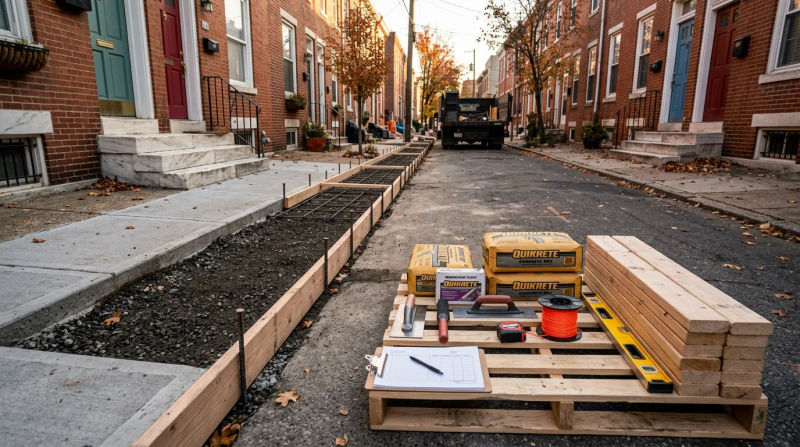
As a Senior Concrete Foreman with over 18 years of experience on jobsites across Delaware County, I know that for most homeowners, the first and biggest question is always about cost. When you see a cracked, uneven, or spalling sidewalk, your mind immediately goes to your budget. You need to know what to expect. This guide is designed to give you a transparent, no-nonsense look at what goes into the cost of concrete sidewalk replacement in Philadelphia, so you can plan with confidence.
Our goal is to demystify the numbers. We believe an informed customer is the best customer, and that starts with understanding the real-world factors that shape the final price. Let's break down the costs, what drives them, and how you can get the best long-term value for your investment.
Average Costs in Philadelphia
When budgeting for a full sidewalk tear-out and replace price in Philadelphia, it’s most helpful to think in terms of cost per square foot. This covers demolition, debris removal, site preparation, materials, and labor. While every project is unique, a realistic price range for a standard 4-inch thick sidewalk in our area is typically $18 to $30 per square foot.
So, for a common 5-foot by 30-foot section of sidewalk (150 square feet), you could expect a price range of approximately $2,700 to $4,500.
Why the range? Philadelphia presents unique challenges that influence this figure. Unlike suburban projects, city work often involves:
- Tighter Site Access: Many of our projects are at classic brick rowhouses built before the 1940s. Access can be limited to the front of the property, meaning all old concrete must be hauled out and all new materials brought in by wheelbarrow, increasing labor.
- High Pedestrian Traffic: We often need to implement more robust safety measures and traffic control to protect the public during work, which requires careful planning.
- Stricter Regulations: Philadelphia has specific codes and liability expectations for property owners regarding sidewalk maintenance. A professional job ensures you meet these standards and avoid potential fines or legal issues.
Factors That Affect Price
The final Philadelphia sidewalk cost isn't just about the size of the slab. Several key variables can shift the price up or down. As a foreman, these are the details my crew and I assess on every single job.
- Demolition and Removal: Is the existing sidewalk just thin, cracked concrete, or is it a thick, old slab reinforced with heavy wire mesh? The more difficult the tear-out, the more labor and time are required. The disposal of this heavy debris is also a significant cost factor.
- Site Access and Logistics: This is one of the biggest Philadelphia sidewalk concrete pricing factors. Can we get a small skid-steer to the area, or does everything have to be done by hand? For many pre-war rowhomes, we have to navigate narrow alleys or even bring materials through the house. This manual labor is intensive and directly impacts the budget.
- Sub-Base Preparation: The foundation beneath your concrete is just as important as the concrete itself. A poor sub-base is the number one reason I see sidewalks fail prematurely. We need to excavate the old material and install a compacted base of crushed stone (like 2A modified). If the underlying soil is unstable or poorly drained, it may require more extensive excavation and a deeper stone base, adding to the cost but ensuring a durable, long-lasting result.
- Concrete Thickness and Reinforcement: A standard sidewalk is 4 inches thick. However, if the sidewalk crosses a driveway apron where vehicles will pass over it, we recommend increasing the thickness to 6 inches and adding rebar or wire mesh for extra tensile strength. This adds to the material cost but is essential for preventing cracks under heavy loads.
- Project Complexity: A simple, straight run of sidewalk is the most straightforward. Costs can increase with features like curves, multiple control joints, or intricate connections to existing structures like porches and steps, which are common in older Philadelphia homes. Ensuring proper drainage and a seamless tie-in requires more detailed forming and finishing work.
- Seasonal Timing: Scheduling work in the late fall, for example, can introduce challenges. As days get shorter in October and November, the window for finishing concrete shrinks. Proper finishing is time-sensitive and can't be rushed before the sun goes down. Additionally, heavy leaf fall can land on and stain freshly poured concrete if not managed carefully.
How to Get the Best Value
Getting the best value isn't about finding the cheapest price; it's about investing in a solution that lasts for decades. In my experience, cutting corners on concrete work almost always leads to more expensive repairs down the road.
- Focus on the Foundation: Don't let a contractor skimp on the sub-base. Ask them to specify the depth and type of stone base they will install. A solid, well-compacted base is your best defense against heaving and cracking.
- Ask for an Itemized Estimate: A professional contractor should be able to provide a clear, line-by-line estimate that breaks down the costs for demolition, materials, and labor. This transparency helps you understand exactly what you're paying for and compare quotes accurately. Some companies, like ours, make this a standard practice to help you budget confidently.
- Bundle Projects if Possible: If you're also considering a new concrete patio or driveway apron, doing it at the same time as your sidewalk can save you money. A contractor's mobilization costs (getting crew and equipment to the site) are spread across a larger job, often resulting in a lower overall price per square foot.
- Hire a Reputable, Insured Professional: A low-ball offer might come from a contractor who lacks proper insurance or doesn't follow city codes. This puts you, the homeowner, at risk. A professional crew will have organized workflows, standardized processes, and the expertise to handle the unique challenges of working in the city.
Questions to Ask Your Contractor
To ensure you're hiring a qualified professional for your concrete sidewalk replacement Philadelphia project, here are some essential questions to ask:
- Are you fully licensed and insured to work in the City of Philadelphia?
- Does your estimate include all costs for demolition, hauling, and disposal?
- What type and depth of sub-base will you be installing?
- What is the specified thickness and PSI (strength) of the concrete you will use?
- Will you be using reinforcement like wire mesh or rebar? Why or why not?
- How will you manage site protection, cleanup, and pedestrian safety?
- Who handles the permitting and inspection process with the city?
- Can you provide a detailed project timeline from start to finish?
Having managed hundreds of residential projects, I can tell you that a contractor who can answer these questions clearly and confidently is one who takes their craft seriously. It shows they have the experience and processes in place to deliver a quality product.
Replacing a sidewalk is a significant investment in your property's safety, function, and curb appeal. By understanding the factors that influence cost and knowing what to look for in a contractor, you can ensure your project is done right the first time. It’s about creating a safe, durable surface that will serve you and your neighborhood well for years to come.
For a personalized, itemized estimate in Philadelphia, contact Chris Falcone Concrete for a free consultation.