

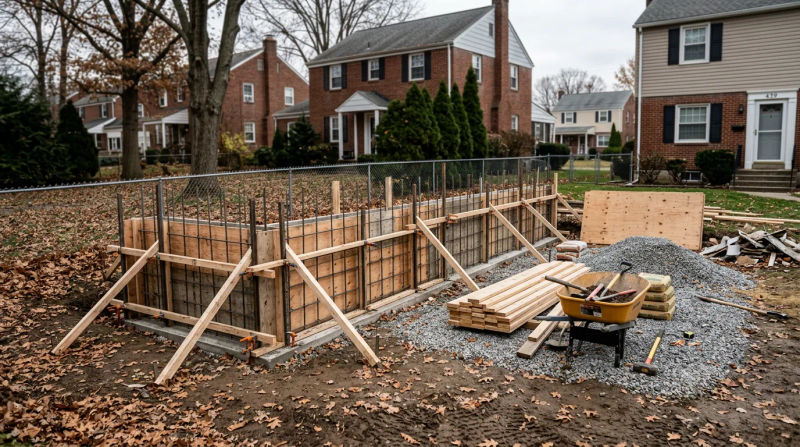
When homeowners in Glenolden start planning for a new poured concrete wall, one of the first and most important questions is always about cost. It's a significant investment, and you deserve to know what goes into the final price. In my 18 years as a Senior Concrete Foreman, I've managed hundreds of wall projects, and my goal here is to give you a transparent look at what to expect, so you can budget with confidence.
We believe in clear communication. This guide will break down the typical costs for concrete walls in our area and explain the key factors that influence your final quote.
Average Costs in Glenolden
Providing a flat rate for concrete work is impossible because every single job is unique. However, I can share some realistic budget ranges to help you get started. For a standard poured concrete wall in the Glenolden area, homeowners can generally expect the concrete wall price per linear foot to fall between $95 and $160.
So, for a 50-foot-long wall, you might budget anywhere from $4,750 to $8,000. This range accounts for a standard 4-foot high retaining wall or foundation wall with straightforward access.
Why such a wide range? The Glenolden PA poured concrete wall cost is heavily influenced by local conditions. Many of our neighborhoods feature homes built in the post-WWII era of the 1940s - often brick twins or Cape Cods on smaller lots. This density means tighter access for our equipment and trucks, which can affect logistics and labor hours. A job that requires a concrete pump truck because a ready-mix truck can't get close will naturally have a different cost structure than one with wide-open access.
Factors That Affect Price
The final concrete wall cost is a sum of several parts. Understanding these variables will help you understand your contractor's estimate. Our technicians are trained to evaluate each of these factors on-site to build an accurate, itemized quote.
- Wall Dimensions (Height, Length, and Thickness): This is the most direct cost factor. A taller, longer, or thicker wall requires more concrete, more steel rebar for reinforcement, and larger, more robust forms. A simple 3-foot garden wall will cost significantly less than an 8-foot foundation wall for a home addition.
- Site Preparation and Excavation: Before we can pour, we have to prepare the ground. This includes excavating for a stable footing, which is the base the wall sits on. The cost here depends on soil conditions, the presence of large rocks or roots, and the amount of dirt that needs to be removed from the site. On older 1940s properties, we sometimes encounter old, buried foundations or unknown utility lines that require careful work.
- Site Accessibility: As mentioned, access is a major variable in Glenolden. Can a full-size concrete truck reach the pour site? Or will we need to use a pump truck or powered wheelbarrows to transport the concrete? Tight spaces between homes can limit the size of our excavation equipment, potentially increasing labor hours.
- Forming and Rebar Costs for Concrete Walls: This is a critical component of both the cost and the quality of the wall. Forms are the temporary molds that hold the wet concrete in its desired shape. Straight, simple walls are straightforward to form. However, walls with curves, corners, or steps require significantly more custom carpentry and time, increasing labor costs. Rebar (steel reinforcement bars) is the skeleton of the wall, providing the tensile strength concrete lacks. The amount of rebar needed is determined by engineering requirements, especially for retaining walls holding back soil, and directly impacts material costs.
- Concrete Mix and Strength: Concrete isn't one-size-fits-all. It's specified by its compressive strength, measured in PSI (pounds per square inch). A simple landscape wall might only need a 3000 PSI mix, while a structural foundation or retaining wall may require a 4000 or 4500 PSI mix, which costs more per cubic yard.
- Drainage and Waterproofing: For retaining walls and foundation walls, proper drainage is non-negotiable to prevent hydrostatic pressure from damaging the wall over time. This can include adding gravel backfill, perforated drain pipes (French drains), and applying a waterproofing membrane to the wall - all of which are essential for longevity and add to the project cost.
- Finishes: The final look of your wall also affects the price. A standard, smooth, or light broom finish is the most cost-effective. If you want a decorative finish like stamped patterns (to mimic stone or brick) or an exposed aggregate look, expect to pay more for the extra materials and specialized labor involved.
How to Get the Best Value
Getting the best value doesn't mean finding the cheapest price. In my experience, the lowest bid often leads to costly repairs later. Value comes from a durable, correctly installed wall that will last for decades.
- Prioritize a Quality Installation: A wall that cracks or leans in five years because of a poor footing or missing rebar is no bargain. Invest in a contractor with trained crews and standardized processes who doesn't cut corners on materials or prep work.
- Handle Simple Prep Work: If you're able, you can save a small amount on labor by clearing the work area of landscaping, debris, or furniture yourself. Especially in the fall, managing heavy leaf fall before the crew arrives can help streamline the excavation process.
- Plan for the Long Term: When getting quotes, ask about the specifics. What is the footing depth? What is the rebar spacing? A contractor who can confidently explain these details is focused on building a lasting product.
- Keep the Design Simple: If your budget is tight, stick to straight lines and standard finishes. Complex curves and decorative elements are beautiful but are the first place to look for savings.
Questions to Ask Your Contractor
When you meet with a potential contractor, you are interviewing them for a critical job. Be prepared with these questions to ensure you're hiring a true professional:
- Is your company fully licensed and insured in Pennsylvania? (This is non-negotiable for protecting you and your property.)
- Does your quote include all costs? (Make sure excavation, materials, rebar, labor, and site cleanup are all itemized.)
- What PSI concrete mix will you use for my wall?
- Can you describe the footing dimensions and rebar schedule for this project?
- How will you manage site access and protect my lawn and surrounding property?
- What is the estimated timeline from start to finish?
An experienced foreman or estimator should be able to answer these questions clearly and confidently.
Hopefully, this guide has given you a clearer picture of what goes into pricing a concrete wall. The key is understanding that every element, from the thickness of the rebar to the accessibility of your yard, plays a role in the final cost. A well-built wall is a permanent addition to your property, and it’s worth the effort to get it right. If you’re budgeting for a wall before winter, a professional can provide an itemized estimate that reflects access, forming, and schedule constraints common in Glenolden.
For a personalized, no-obligation estimate in the Glenolden area, contact Chris Falcone Concrete for a free consultation. Our team would be happy to assess your project and provide a detailed quote.