
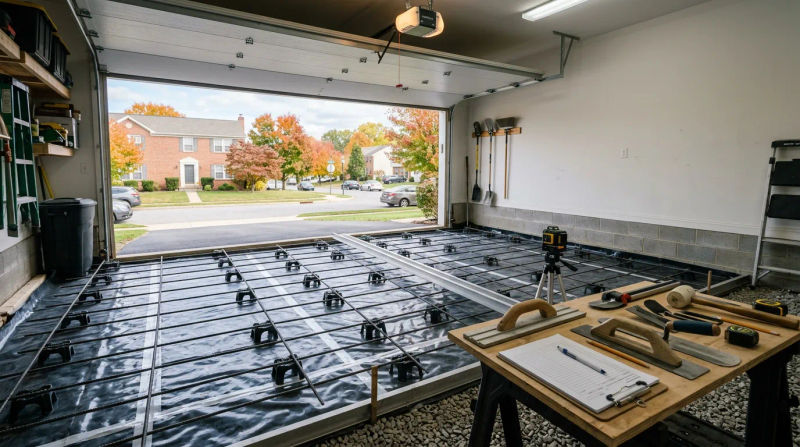
When homeowners in Folsom start planning for a new concrete floor, one of the first and most important questions is always, "What's this going to cost?" As a Senior Concrete Foreman with 18 years in the field, I understand that budget is a primary concern. My goal here is to give you a transparent, no-nonsense guide to understanding the real concrete floor cost for your home, whether you're finishing a basement or replacing an old garage slab. We'll break down the numbers, explain the variables, and empower you to make an informed decision for your property.
Average Costs in Folsom
In our area, a straightforward concrete floor installation has a general price range, but it's crucial to understand this is a starting point. The final price depends heavily on the specifics of your project. As the leaves begin to fall in October, it's an ideal time to get quotes and schedule a pour before consistently cold nights arrive and start to slow down the concrete curing process.
Here are some realistic price ranges you can expect in the Folsom area:
- Standard Garage Floor (approx. 400-600 sq. ft.): For a typical two-car garage requiring a standard 4-inch thick slab with wire mesh reinforcement, you can generally budget between $8 to $12 per square foot. This often includes basic site preparation on a level surface.
- Basement Concrete Floor (approx. 800-1,200 sq. ft.): A new basement concrete floor estimate often falls between $7 and $11 per square foot. The cost can be slightly lower than a garage because it's not exposed to the same weather extremes or vehicle loads, but access challenges can increase labor costs.
- Heavy-Duty Garage or Workshop Floor: If you plan to park heavy trucks, install a car lift, or use the space as a serious workshop, you'll need a thicker slab (5-6 inches) with rebar reinforcement. The Folsom garage slab price for this type of application typically ranges from $10 to $15+ per square foot due to the extra material and labor.
Many homes in Folsom were built in the post-war 1940s boom. From my experience, these sturdy brick and siding homes often have original concrete floors in basements and garages that may now be cracked, uneven, or settled after 70+ years. This means demolition and removal are often necessary before a new slab can be poured, which is a significant factor in the final cost.
Factors That Affect Price
A quote is more than just a single number; it's a summary of labor, materials, and expertise. Here’s what drives the cost up or down.
- Site Preparation and Demolition: Is there an old, cracked slab that needs to be broken up and hauled away? This is labor-intensive and requires heavy equipment. The ground beneath also needs to be properly graded and compacted. If your existing surface is just dirt or gravel, the prep work is simpler and less costly than a full demolition.
- Excavation and Stone Base: We can't just pour concrete on dirt. A proper installation requires a compacted base of crushed stone (like 2A modified stone) at least 4 inches deep. This provides a stable foundation and helps with drainage, preventing future cracking and heaving. The amount of excavation and stone needed directly impacts the price.
- Concrete Slab Thickness & Reinforcement: The concrete slab thickness price is a major variable. A standard 4-inch slab is fine for foot traffic and passenger cars. For heavier loads, a 5 or 6-inch slab is necessary. Reinforcement is also key. Wire mesh is standard for light-duty slabs, while a grid of steel rebar provides far superior strength for heavy-duty applications and is essential for longevity.
- Access to the Job Site: How will our technicians get the concrete to the pour site? For a garage with driveway access, we can often pour directly from the truck chute. For a basement in a Folsom Cape Cod with narrow stairs and tight corners, we may need to use a concrete pump or a team of laborers with wheelbarrows, which significantly adds to the labor time and cost.
- Finishing and Sealing: The finish affects both appearance and function. A smooth, power-troweled finish is standard for garages, making them easy to clean. A simple broom finish provides more texture and is common for basement utility areas or walkways. Applying a high-quality sealer after the concrete cures is an added cost, but one I always recommend to protect the surface from stains, salt, and moisture.
How to Get the Best Value
Getting the best value doesn't mean finding the cheapest price. In concrete work, cutting corners on prep or materials almost always leads to costly repairs down the road. True value comes from a durable, long-lasting installation.
- Prioritize Preparation: The most common cause of slab failure I see is a poorly prepared base. Insist that your contractor includes a proper compacted stone base in the quote. Paying a little more for good prep work is the best investment you can make.
- Get an Itemized Quote: A professional quote should break down the costs: demolition, excavation, materials (cubic yards of concrete, stone), labor, and finishing. This transparency allows you to compare bids accurately. A company like Chris Falcone Concrete will provide an itemized estimate so you can see exactly what you're paying for.
- Think Long-Term: A slightly thicker slab or upgrading from wire mesh to rebar might add 10-15% to the upfront cost, but it can double the strength and lifespan of your floor, saving you from premature cracks and replacement costs.
- Clear the Area: You can save on labor costs by clearing the garage or basement yourself before the crew arrives. Removing all stored items, shelving, and debris allows our team to get to work immediately.
Questions to Ask Your Contractor
Before you sign a contract, you should feel confident in the contractor's plan. Here are the questions I'd ask if it were my own home:
- Is demolition, debris removal, and site cleanup included in the price?
- What is the planned thickness of the stone base, and how will it be compacted?
- What is the planned concrete slab thickness, and what type of reinforcement (wire mesh or rebar) will be used?
- What is the PSI (strength rating) of the concrete mix you're using? (4000 PSI is a good standard for garage slabs).
- How do you plan to handle access to the pour site?
- Does the quote include control joints to help prevent random cracking?
- Can you provide proof of your license and insurance?
An experienced and reliable contractor will have clear, confident answers to all these questions. Their willingness to discuss the technical details is a great sign of their professionalism.
Investing in a new concrete floor is a significant upgrade for your home. By understanding the factors that influence cost and knowing what to look for in a quality installation, you can budget effectively and ensure you get a durable, well-built floor that serves you for decades. A proper slab is a foundation for your space, and it pays to get it right the first time.
For a personalized and detailed basement concrete floor estimate in the Folsom area, contact Chris Falcone Concrete for a free consultation.